
How to Plan a Safe & Successful Fall Carnival with Inflatables in Western NC
When a fall carnival goes well, families rarely notice the planning behind it. Kids see bounce houses, obstacle courses, and friends. Parents see a fun afternoon. The planning committee sees something else: attendance estimates, volunteer schedules, electrical access, weather forecasts, and dozens of details that need to work together.
If you're organizing a school carnival, church fall festival, or community event in Asheville, Hendersonville, or elsewhere in Western North Carolina, the goal isn't simply to rent a few inflatables—it's to create an event that flows well, gives different age groups something to enjoy, and doesn't leave volunteers solving avoidable problems all afternoon.
📋 What's in This Guide
- Start With Your Crowd Before Choosing Inflatables
- Choosing the Right Inflatable Mix
- Your Carnival Layout Matters More Than You Think
- Western NC Venues Aren't Always Perfectly Flat
- Plan the Power Before Equipment Arrives
- Give Every Volunteer a Job Before the Carnival Starts
- Make Weather Decisions Before Weather Makes Them for You
- How Early Should You Book Fall Carnival Inflatables?
- Frequently Asked Questions
🎪 You're a School PTO Member
You're planning a fall carnival for hundreds of students across multiple grades. You need attractions that work for different ages, a layout that prevents bottlenecks, and volunteer assignments that don't overwhelm your team. This guide shows you how to plan the entire event, not just rent equipment.
⛪ You're Organizing a Church Fall Festival
Your congregation includes toddlers, teens, and everyone in between. The event needs to feel welcoming and family-friendly while actually being safe and organized. This guide helps you create variety without chaos and plan details that volunteers can actually execute.
🏘️ You're Planning a Community Fundraiser
You're hosting an outdoor event for your neighborhood, nonprofit, or organization. You need something that draws families, keeps children entertained, and creates a memorable afternoon. This guide shows you what works for Western NC venues and how to think through the logistics before problems appear.
Start With Your Crowd Before Choosing Your Inflatables
Don't start with the inflatable. Start with the people attending.
Before choosing equipment, get clear on: expected attendance, children's age range, event length, available setup space, setup surface, electrical access, number of available volunteers, other attractions and concessions, overall budget, and weather contingency plans.
💡 Pro Tip: The right setup for 75 elementary-age children isn't necessarily the right setup for a school-wide carnival expecting several hundred people. Age matters, too. A bounce house that keeps younger children happily occupied may not hold an older student's attention the way an obstacle course will.
And if you're expecting toddlers, elementary students, teenagers, parents, and grandparents at the same event, variety becomes even more important.
Instead of asking, "What's the coolest inflatable?" ask, "What's going to work best for this crowd?" That question leads to a much better event.
Choosing the Right Inflatable Mix for Your Fall Carnival
For a smaller event, one main inflatable may be plenty. For a larger school, church, or community carnival, different types of attractions can help spread guests throughout the event while giving different age groups something they'll actually want to do.
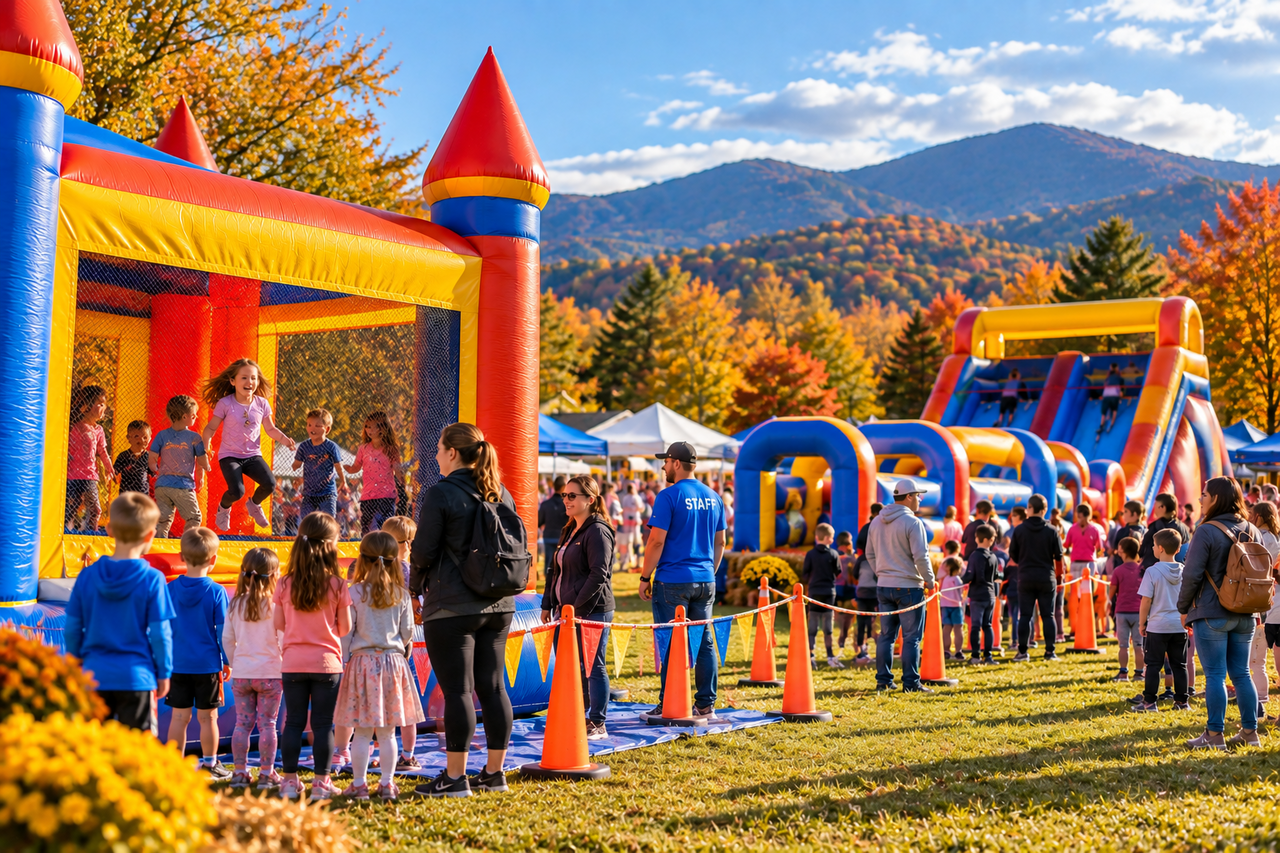
Bounce Houses: A Natural Starting Point for Younger Kids
There's a reason bounce houses remain a party staple. Kids understand them immediately.
For an event with lots of younger children, a bounce house can provide a dedicated attraction that feels appropriate for their age group. If you're expecting a broad range of ages, consider whether younger participants would benefit from having an attraction separate from bigger, faster-moving kids.
Browse All Fun Bouncing's bounce house rentals to see the available options.
Obstacle Courses: Give Bigger Kids Something to Conquer
Older children often want more than open bouncing. They want a challenge.
An inflatable obstacle course adds climbing, crawling, racing, and friendly competition. It also gives your carnival a distinctly different attraction instead of several variations of the same activity. For school carnivals in particular, that variety can matter when you're entertaining children across multiple grades.
See All Fun Bouncing's inflatable obstacle courses when planning your activity mix.
Combo Units: More Variety in One Attraction
If your event has limited setup space or you can't accommodate several separate inflatables, a combo unit may be worth considering. Depending on the particular unit, kids can get more than one type of activity within a single inflatable.
That's useful when you're trying to make good use of the space you have rather than simply fitting in as much equipment as possible.
Explore the available bounce houses with slides.
Water Slides: Don't Rule Them Out Just Because It's Fall
September in Western North Carolina doesn't automatically mean water attractions are off the table. But a water slide should fit the actual conditions and layout of your event.
⚠️ Before including a water slide, consider:
- Expected temperature and event time
- Water access and drainage
- Ground conditions
- How wet guests will move through the event
- Your alternative if conditions aren't suitable
If a water attraction makes sense for your date and venue, explore All Fun Bouncing's water slide rentals.
And if you're mixing wet and dry attractions, decide where each will go before finalizing the layout. Wet kids and dry concession areas don't always make the best neighbors.
Your Carnival Layout Matters More Than You Think
Choosing great attractions is only half the job. Now imagine putting them in all the wrong places.
One long line blocks the main walkway. Kids leaving an inflatable run into kids waiting to enter. The concession queue crosses another activity. Everyone seems to be congregating in the same corner of the property.
A simple site plan can prevent a lot of that.
Before Event Day, Sketch Out:
- Entrances and exits
- Inflatable locations
- Waiting areas
- Food and concessions
- Seating and restrooms
- Electrical access
- Main pedestrian routes
- Wet and dry areas
It doesn't need to be fancy. You're trying to answer one question: How will people actually move through this event?
Leave Room Around Each Attraction
Don't plan your site around an inflatable's dimensions alone. The setup also needs appropriate operating space around the unit, including room for entry and exit, equipment, securing the inflatable, and supervision.
Exact requirements depend on the rental and setup location, so confirm them for your chosen equipment before finalizing the event map. This becomes especially important when several attractions and their waiting areas have to share the same property.
Decide Where the Line Goes Before There Is a Line
Popular attractions attract people. That's good. The problem starts when nobody knows where those people should stand.
Give each major attraction an obvious waiting area that doesn't block main walkways, other attractions, food lines, seating, emergency access, or entrances and exits.
It sounds like a small detail. It doesn't feel small when 30 excited children arrive at once.
↓ What Keeps Carnival Lines Manageable
- Clear designated waiting areas
- Variety of attractions to distribute crowds
- Visible signage showing where to queue
- Separate entrance/exit paths where possible
- Strategic placement away from main walkways
↑ What Creates Carnival Bottlenecks
- Lines blocking main pedestrian routes
- Entry and exit traffic crossing each other
- All attractions clustered in one area
- No clear indication of where to wait
- Food lines intersecting activity areas
Keep Wet Activities Together
If your carnival includes a water slide or another wet attraction, consider creating a wet zone rather than scattering wet and dry activities across the site. Think about drainage and how the surrounding ground may change as the event continues.
Then ask another practical question: Where do kids go after getting wet? If the answer is "straight through the food area," rethink the route.
Give Food and Seating Their Own Space
Families need somewhere to slow down. Keep food and concession areas far enough from active inflatables that neither area interferes with the other.
That gives parents somewhere to sit, lets children eat away from the attractions, and helps keep food and drinks out of inflatable entry areas.
If your event needs additional gathering or eating space, All Fun Bouncing also offers tent, table, and chair rentals.
Western NC Venues Aren't Always Perfectly Flat
One thing worth considering early in Asheville, Hendersonville, and the surrounding Western North Carolina area is the property itself. School fields, church grounds, parks, and community spaces can give you plenty of room without necessarily giving you a perfectly flat setup area.
Don't judge the site from the parking lot. Walk it.
Look Closely at the Ground
Check proposed setup areas for:
- Noticeable slopes
- Uneven terrain
- Soft or muddy ground
- Drainage areas
- Obstacles
- Heavy-traffic routes
Requirements depend on the individual inflatable and site conditions, so don't assume an area will work simply because its dimensions appear large enough. If you're unsure about the intended setup location, discuss the site with All Fun Bouncing before event day.
Think About What Hundreds of Feet Will Do
The ground at the beginning of an event may not look the same after hundreds of guests have followed the same route for several hours. That's especially worth considering after recent rain.
Plan major walkways and queues with ground conditions in mind, particularly around entrances and popular attractions.
Treat Wind as a Safety Issue, Not an Inconvenience
🚨 Safety First: Weather conditions matter when inflatables are being used outdoors. Follow the operating requirements for your rented equipment and any safety instructions provided by All Fun Bouncing. If changing conditions mean an attraction needs to stop operating, don't try to work around a safety requirement just to keep the carnival schedule intact.
When in doubt, contact the team and follow the guidance provided for your specific rental.
Plan the Power Before the Equipment Arrives
A school carnival with several inflatables requires more electrical planning than simply finding the nearest outlet.
Inflatables require power for their blowers, and organizers need to know where suitable power will come from and how it will reach the equipment. Before event day, confirm the electrical requirements for the specific rentals you've selected, including outlet availability, power-source locations, and whether additional equipment will be necessary.
💡 Why This Matters Early: Don't assume several inflatables can simply be plugged into whatever outlets happen to be nearby. For a multi-unit event, tell All Fun Bouncing what attractions you're considering and what power is available at the venue so the requirements can be addressed before setup day.
This is why it helps to discuss the carnival as one event, rather than treating every rental as a separate decision. Give the team the full picture: crowd size, age range, venue, available space, event hours, and the attractions you're considering.
Give Every Volunteer a Job Before the Carnival Starts
A good layout won't help much if nobody knows who's responsible for what.
Avoid a plan that depends on somebody eventually asking: "Can you watch this for a few minutes?"
Establish responsibilities before guests arrive. Depending on your event and the requirements for the equipment, that may include attraction supervisors, line-management volunteers, break coverage, a volunteer coordinator, and one primary event contact.
Confirm the supervision and operating requirements for your particular rentals with All Fun Bouncing, then build your volunteer plan around them.
📋 Rotate Volunteers
Someone who happily volunteers for one shift may feel differently about being stationed beside the same attraction for the entire carnival. If staffing allows, divide longer events into manageable shifts and make the handoffs clear.
📝 Put Rules Where Families Can See Them
Don't make volunteers explain the same basic instructions from scratch to every group. Use clear signage for: where the line begins, entry/exit points, participation restrictions, shoes and prohibited items, food and drink rules, and equipment-specific requirements.
✅ Good Signage Makes Supervision Easier
Use the actual requirements for the rented equipment rather than creating generic safety rules. Good signage doesn't replace active supervision—it makes supervision easier.
Make Weather Decisions Before the Weather Makes Them for You
Outdoor fall events come with uncertainty. A cooler morning can become a warmer afternoon. Rain can change ground conditions. Wind or storms can affect whether outdoor activities can continue safely.
You don't need to predict everything. You need to know what you'll do if conditions change.
Know the Weather Policy Before Event Day
Ask about applicable weather procedures and booking terms when you reserve your equipment. Make sure the person coordinating the event understands what happens if conditions affect setup or operation and knows who to contact if the forecast becomes a concern.
That conversation is much easier to have in advance than while families are arriving.
Put One Person in Charge of Weather Communication
Decide beforehand:
- Who monitors conditions
- Who communicates with All Fun Bouncing
- Who makes event-level decisions
- How volunteers will be notified
- How attendees will receive updates
When conditions change, six people making six separate decisions isn't helpful. A clear chain of communication is.
Have a Backup Plan You'd Actually Use
"Hopefully it'll be fine" isn't much of a contingency plan.
Depending on your venue and event, alternatives could include adjusting the schedule, moving eligible activities indoors, modifying the activity lineup, using covered areas for other parts of the event, or following the applicable rescheduling procedure.
Decide what your realistic alternatives are before you need them.
How Early Should You Book Fall Carnival Inflatables?
Large events deserve more planning time than a last-minute backyard party.
A school carnival or church festival may involve multiple rentals, internal approvals, volunteer schedules, electrical planning, vendors, site logistics, and documentation. Waiting until everything else is finalized before thinking about inflatables can leave you with fewer options.
If you already know your preferred fall event date, contact All Fun Bouncing early enough to discuss availability and logistics rather than assuming a particular unit or combination will still be available.
Establish the Basics
Confirm your date, venue, expected attendance, age range, event hours, approximate budget, and usable setup space. Then start discussing attraction availability.
Finalize Event Layout
Once you've selected your rentals, work through placement, power requirements, venue requirements, volunteer needs, food areas, and other event logistics.
Get Everyone on the Same Page
Complete volunteer assignments and prepare any necessary signs, maps, schedules, and communication plans. Review final logistics and your weather plan before event day.
One Mistake Worth Avoiding: Planning Every Attraction Separately
It's easy for committees to divide the carnival into pieces. One person handles inflatables. Someone else handles food. Another recruits volunteers. Someone finds tables. Someone manages parking.
Individually, everything looks fine. Then event day arrives and all those pieces have to occupy the same property at the same time.
That's why the better planning question isn't simply: "Will this inflatable fit?" It's: "How does this inflatable fit into the entire event?"
🚩 Questions to Ask About Each Attraction:
🚩 Where does its line go?
🚩 What's beside it?
🚩 Where are parents standing?
🚩 Where's the nearest food area?
🚩 How are guests reaching it?
🚩 Where is the power coming from?
🚩 What happens if the ground gets wet?
🚩 Who is responsible for supervising?
Those questions aren't as exciting as choosing attractions. They're often what separates a carnival that looks good on paper from one that actually feels organized once families arrive.
The Best Carnival Is the One Everyone Gets to Enjoy
The children attending your carnival don't know about your planning spreadsheet. They don't know who spent an evening working out the site map or how many messages it took to fill the volunteer schedule.
They just know they got to race a friend through an obstacle course, bounce until they were tired, eat something delicious, and spend an afternoon having fun.
That's the point.
Good planning isn't about making an event rigid. It's what allows the event to feel easy.
Choose attractions around your crowd. Give them enough space. Think through traffic and power. Make volunteer responsibilities clear. Have a real weather plan.
Sort out the difficult questions before event day, and your committee can spend less time solving problems and more time enjoying the carnival you worked so hard to create.
Frequently Asked Questions About Fall Carnival Inflatable Rentals
Can we rent multiple inflatables for one event?+
For a multi-inflatable school, church, or community event, contact All Fun Bouncing with the details of what you're planning and the rentals you're considering. Be ready to share your expected attendance, age range, event hours, available space, surface type, and venue information. Looking at those details together makes more sense than choosing each attraction in isolation.
Do you provide proof of insurance?+
Insurance and documentation requirements can vary between schools, churches, municipalities, venues, and other organizations. Check what your organization or venue requires, then contact All Fun Bouncing to confirm what documentation is available for your event.
How long does setup take for a large event?+
Setup time can vary depending on the number and type of rentals, access to the setup area, site conditions, electrical arrangements, and other event-specific factors. If your carnival has a fixed opening time, provide that information when arranging your rentals so setup logistics can be discussed in advance.
What should we have ready when we contact All Fun Bouncing?+
You don't need every detail figured out, but having the basics ready makes the planning conversation much more useful:
- Event date
- Venue/address
- Event hours
- Expected attendance
- Children's age range
- Approximate budget
- Available setup space
- Surface type
- Electrical access
- Attractions you're considering
If the venue has unusual features—such as slopes, restricted access, limited setup areas, or other concerns—mention those as well.
Can All Fun Bouncing help us choose inflatables for our carnival?+
If you're unsure which rentals make sense for your event, start with the crowd rather than a particular inflatable. Tell All Fun Bouncing who's attending, approximately how many guests you're expecting, what space you're working with, and what kind of experience you're trying to create. From there, you can discuss the available rental options that fit the event.
Looking for Fall Carnival Inflatable Rentals in Western North Carolina?
All Fun Bouncing serves the Asheville–Hendersonville area with premium inflatable entertainment for private and community events. The focus is simple: clean, regularly updated equipment, professional service, safety, reliability, and customer satisfaction.
If you're comparing fall carnival inflatable rentals in Western North Carolina for a school carnival, church fall festival, fundraiser, or community celebration, don't wait until every other part of the event is finished before thinking about the inflatable setup.
Bring the rental conversation into the planning process while you still have room to make good decisions.
Check AvailabilityNo pressure, no pitch — just helpful planning guidance for your fall carnival